
Understanding how to convert time units effectively is essential for students, professionals, and anyone working with temporal data. While we experience time daily, translating vast quantities of seconds or minutes into comprehensible years requires specialized calculation tools.
The Essential Time Converters Explained
Converting Seconds to Years
Seconds represent our most granular standard measurement of time. When confronting enormous numerical values millions or billions of seconds comprehension becomes challenging. Conversion calculators solve this by instantly translating second counts into year equivalents.
The Mathematical Foundation:
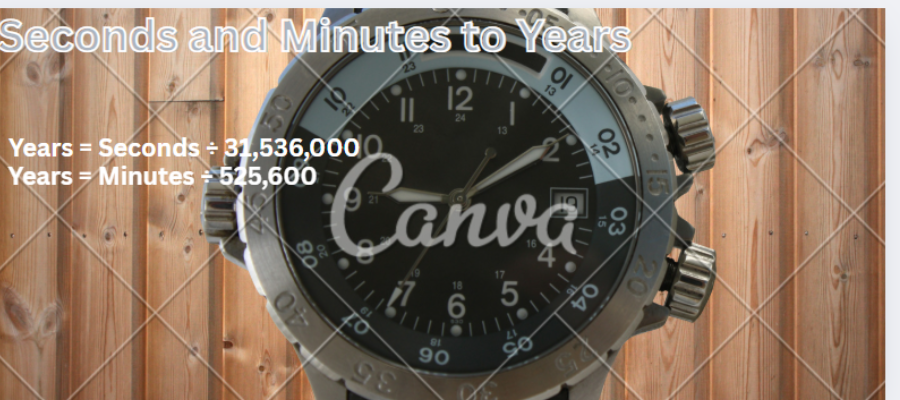
Years = Seconds ÷ 31,536,000
This divisor comes from: 365 days × 24 hours × 60 minutes × 60 seconds
Practical Examples:
- 31,536,000 seconds equals exactly 1 year
- 94,608,000 seconds equals 3 years
- 1 billion seconds approximately equals 31.69 years
These calculators prove invaluable for software developers, researchers, and technical professionals handling raw temporal data.
Converting Minutes to Years
Minutes serve as our everyday time unit for scheduling meetings, tracking activities, and planning events. Converting substantial minute counts into years helps visualize extended timeframes more effectively.
The Calculation Method:
Years = Minutes ÷ 525,600
Derived from: 365 days × 24 hours × 60 minutes
Real-World Examples:
- 525,600 minutes equals 1 year
- 2,628,000 minutes equals 5 years
- 10 million minutes approximately equals 19.03 years
This converter benefits project coordinators, academic researchers, and anyone analyzing time-based information.
Side by Side Comparison
| Aspect | Seconds Converter | Minutes Converter |
| Starting Unit | Seconds | Minutes |
| Best Applications | Scientific research, technical systems, precision requirements | Business planning, academic projects, general calculations |
| Detail Level | Extremely precise for massive numbers | Suitable for practical large values |
| Sample Conversion | 500 million seconds ≈ 15.85 years | 500,000 minutes ≈ 0.95 years |
| User Experience | Optimal for technical accuracy | Intuitive for common scenarios |
Key Takeaway: Technical and scientific work benefits from second based calculations, while practical planning scenarios work better with minute-based conversions.
Advantages of Online Conversion Tools
Immediate Calculation – Enter your value and receive instant year conversions without manual arithmetic.
Reliable Precision – Calculators utilize standardized astronomical year measurements for consistent accuracy.
User-Friendly Design – Intuitive interfaces welcome users of all technical backgrounds.
Efficiency Gains – Eliminate tedious manual calculations, especially with large numerical values.
Learning Enhancement – Students grasp temporal relationships between units and build practical mathematical skills.
Real World Application Scenarios
IT Professionals monitoring server uptime measured in seconds can quickly determine operational years for reporting and maintenance planning.
Business Managers tracking cumulative project hours in minutes can visualize multi-year timelines for strategic planning.
Educators and Students solving temporal problems can verify calculations rapidly, enhancing learning efficiency and comprehension.
Data Analysts processing large temporal datasets can standardize measurements into years for clearer trend analysis and reporting.
Selecting the Right Conversion Tool
Your specific needs determine which calculator serves you best:
Choose Seconds to Years when:
- Working with ultra precise technical measurements
- Analyzing extremely large time spans
- Processing system generated temporal data
- Requiring maximum accuracy in scientific contexts
Choose Minutes to Years when:
- Performing everyday practical conversions
- Calculating project or event durations
- Working with human scale time measurements
- Needing accessible, straightforward results
Final Thoughts
Both conversion tools serve distinct yet complementary purposes in understanding temporal measurements. Rather than competing, they address different scales and precision requirements within time calculation.
For comprehensive time conversion capabilities, having both calculators available ensures users can handle any temporal conversion challenge from microsecond precision technical data to broad scale planning scenarios. These tools transform complicated calculations into simple, accessible insights, making time comprehension universal and practical for all users.
https://khaleejtimes.in/